
Why Collectors Love the Herend Chinese Bouquet Apponyi Pattern
Ask a collector in Budapest about Apponyi and a collector in the United States about Chinese Bouquet, and you might not realize they're talking about the exact same porcelain pattern. It's one of the most recognized hand-painted patterns in the world, still painted entirely by hand in one Hungarian village, with a real link to European royalty and a resale market strong enough that individual pieces usually run $40 to $300, with full sets often passing $1,000.

Herend Chinese Bouquet Lilac tea cup and saucer, one of the pattern's less common colorways, set for afternoon tea.
Herend Porcelain: Nearly 200 Years of Hand-Painted History
Herend is a porcelain manufactory founded in a small village in western Hungary in 1826. The factory has never stopped hand-painting its ware, and every piece that leaves the workshop today is still painted by hand, the same way it was nearly two centuries ago. Herend porcelain spans far more than tableware, from full dinner services to Herend figurines and decorative objects, but Herend china patterns like Chinese Bouquet remain what most collectors reach for first.
The brand's reputation was built at the 1851 Great Exhibition in London, where Queen Victoria saw a Herend dinner service decorated with butterflies and peonies and ordered a full set for herself. That pattern was renamed Victoria in her honor, and the royal association stuck. Herend went on to make porcelain for the Habsburgs, the Rothschild family, and aristocratic households across Europe, and it holds a Royal Warrant history that few porcelain makers outside Britain can claim.

A table setting featuring the multicolor colorway of Herend Chinese Bouquet, combining several of the pattern's colors on one plate.
The Origins of the Chinese Bouquet Pattern
Chinese Bouquet grew out of Herend's early habit of studying export porcelain that came into Europe from China in the 1700s and 1800s. Herend's founder-era designers looked at the flowering branches and loose floral sprays on that Chinese export ware and reworked them through their own hand-painting style, using softer brushwork and a different balance of color than the originals.
The pattern itself dates to the 1800s, but it took its familiar modern form and name in the early 1930s, when it was refined and offered to Count Albert Apponyi, a Hungarian statesman. In Hungary, the pattern is still called Apponyi to this day. Outside Hungary, it's sold as Chinese Bouquet, a nod to the Chinese export porcelain that inspired the original floral motifs.
Today the design comes in several colorways, including green (the earliest and most historic), rust, raspberry, blue, black, and full multicolor, each with the same gold-rimmed, symmetrical floral layout. In Hungary, each colorway carries its own Hungarian name and a short decor code, printed on the base of the piece:
| Hungarian Name | English Color |
|---|---|
| Zöld | Green |
| Kék | Blue |
| Narancs | Rust / Orange |
| Purpur | Raspberry / Purple |
| Fekete | Black |
| Sárga | Yellow |
| Lila | Lilac |
| Türkiz | Turquoise, with platinum trim |
| Színes | Multicolor |
Chinese Bouquet vs. Apponyi: Same Pattern, Two Names
Both names describe the same pattern. Apponyi is the name used in Hungary, tied to the Hungarian count the design was created for. Chinese Bouquet is the export name, chosen because the floral sprays trace back to Chinese porcelain motifs rather than a European or Hungarian source. If you see a piece listed under either name with the same gold-edged floral branches, it's the same family of pattern, sometimes just in a different color.

Nine Herend Chinese Bouquet plates, one for each colorway, labeled with their English name, Hungarian name, and decor code.
What is Herend Chinese Bouquet worth today?
Because Chinese Bouquet has been one of Herend's best-selling patterns for decades, the secondary market for it is deep, which keeps prices approachable compared to rarer Herend designs. Here's a rough guide to what pieces bring on the resale market:
| Piece Type | Typical Resale Range |
|---|---|
| Single teacup and saucer | $40 - $120 |
| Dinner plate or salad plate | $60 - $150 |
| Serving platter or tureen | $200 - $1,000+ |
| Complete place setting or full dinner service | $1,000 and up |
A few factors move a piece up or down in value: the color (green and the original historic colorways tend to bring more than newer multicolor pieces), condition, whether the gold trim is intact, and the age of the mark on the base. Pieces with a older, retired factory mark are generally worth more to collectors than current-production pieces in the same pattern.
Why Chinese Bouquet Remains a Collector Favorite
A few things keep Chinese Bouquet at the top of Herend's most-collected patterns, nearly two centuries after Herend first opened:
- It's genuinely hand-painted. Every piece is painted by a person, so no two are painted in exactly the same way, which collectors notice and value.
- It has real royal history. The pattern was created for a Hungarian statesman and sits alongside other Herend patterns made for European royalty, giving it a documented past rather than a marketing story.
- It's easy to build a collection around. Because it was made across so many decades and in several colorways, collectors can build out a set piece by piece, mixing colors or hunting down a specific era.
- It photographs and displays beautifully. The gold rim and open floral branches work in a china cabinet, in a full Herend table setting, or as a single statement piece in a Herend tablescape, which keeps demand steady among people who collect for display rather than for use.
That same combination of hand-painted detail and documented history is exactly what makes broken or retired china pieces from patterns like Chinese Bouquet worth preserving in another form once a set is incomplete. A single surviving piece of a hand-painted pattern still carries the same brushwork and gold that made the full set valuable in the first place.

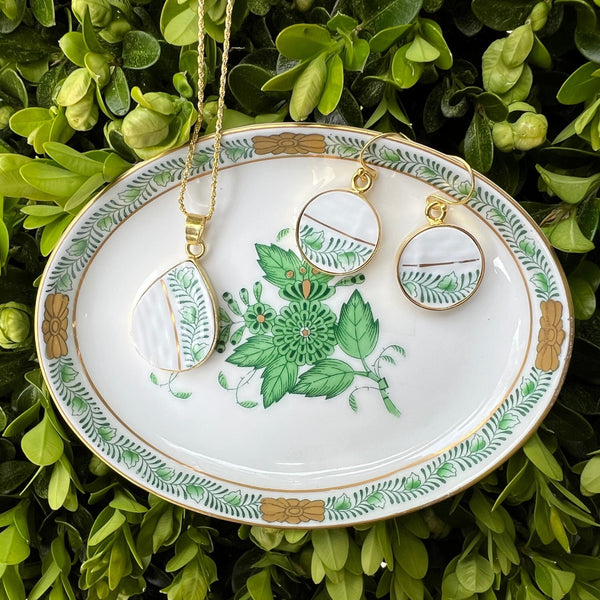
eclectiQuas Herend Chinese Bouquet jewelry collection, featuring the green colorway
eclectiQuas Herend Chinese Bouquet Jewelry Collection
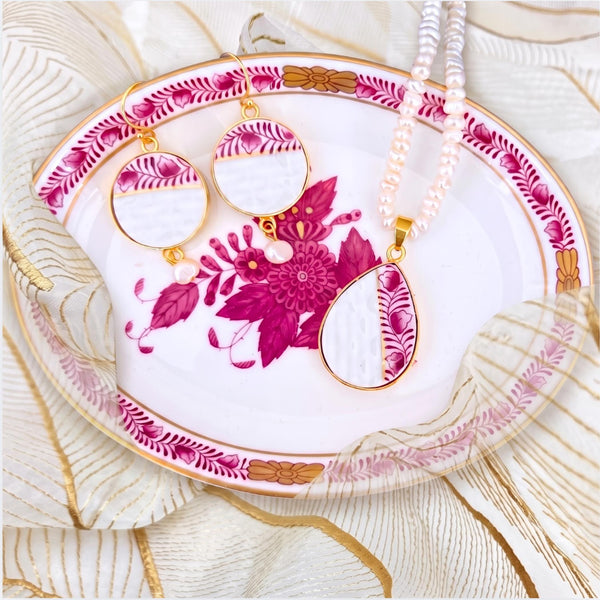
eclectiQuas turns hand-painted china and porcelain into wearable jewelry, and Herend Chinese Bouquet is one of the patterns collectors ask for by name. Each piece starts as a single piece of genuine Herend porcelain, set into jewelry so the pattern's brushwork and gold detail stay front and center.
The collection is available in multiple colors, with each color drawing on the mood of its original Herend colorway, from the historic depth of green to the warmth of rust to the richness of raspberry. Availability shifts as new pieces are found, along with the occasional trinket dish when one comes available.